
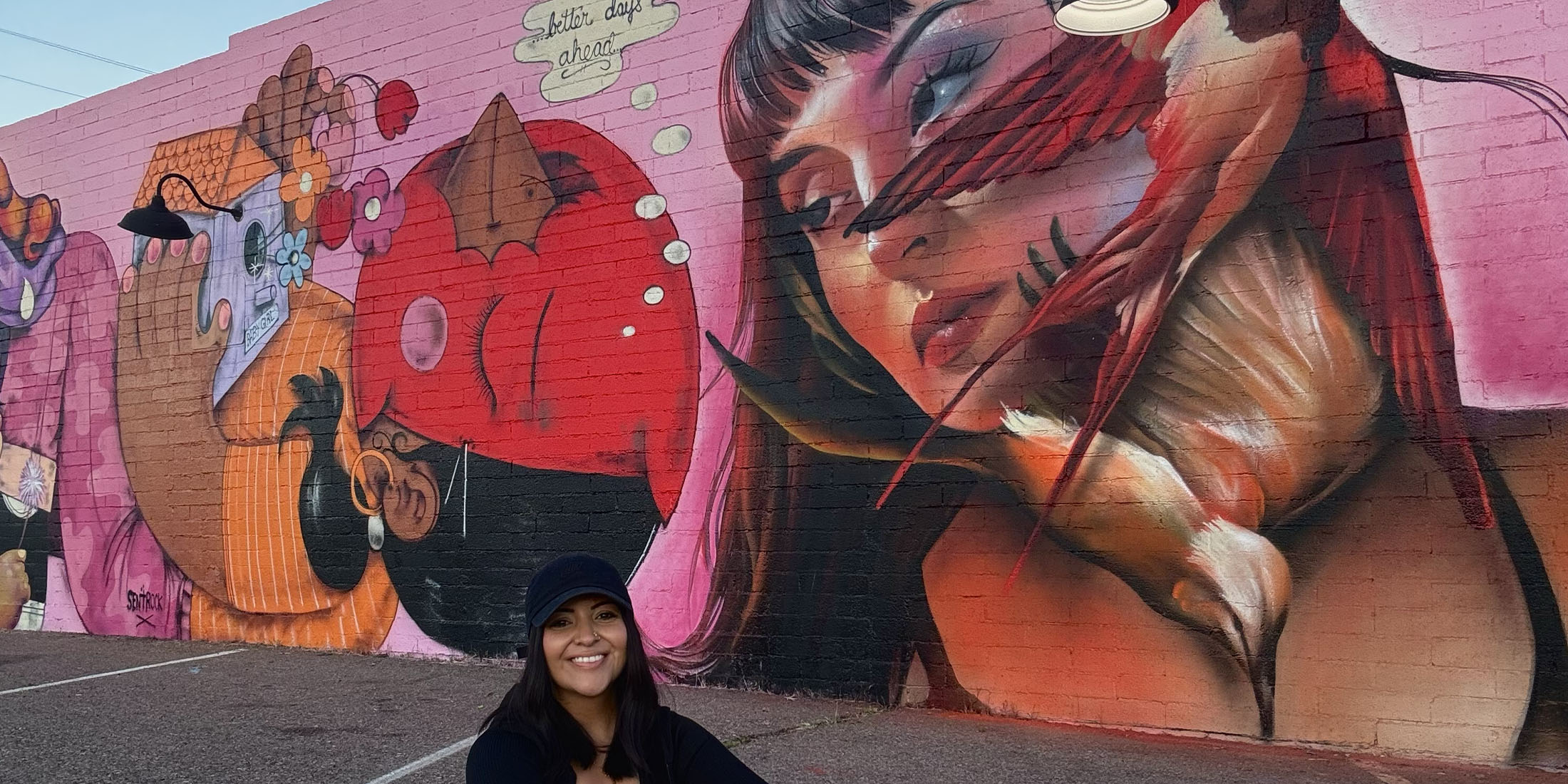
Denver artist, Chelsea Lewinski didn’t just quit her day job; she staged a high-stakes jailbreak from the mundane. In 2019, she ditched the “safety” of a college advisor desk for the raw, grit-and-glory life of a full-time muralist and tattoo artist. Since then, her “raw human truth” has bled onto 40-foot walls and permanent skin alike, turning Denver’s landscape into a diary of resilience and rage. From surviving a career-threatening accident to navigating the male-dominated street art scene with “disruptive softness,” Lewinski proves that “grit” isn’t about burnout—it’s about the courage to be seen.
Tell us a little bit about how you ended up on the crazy path of being an artist.
Honestly, art has always been with me. I remember my earliest memory was middle school, art was my favorite class (thank you, Mr. G). It was something I did on and off throughout my life. I’d draw in my cubicle or when I got home from work. I just didn’t give myself permission to take it seriously.


You quit your office job in 2019 to pursue art full-time and were immediately met with a “whirlwind” of success. Looking back, was there a specific moment during that first month when you realized, “I’m never going back to a desk”?
I remember it perfectly, actually. It was my very first mural, and it happened the same week I quit my job as a college advisor. I had been using all my sick days just to get started on the wall. Toward the end of that week, I knew I couldn’t keep calling out, so I finally went to work with the intention of quitting because the only thing I wanted to do was finish the mural. The moment I walked in, my boss already knew. He said, “You’re leaving us, aren’t you?” It was like I had woken up to this whole new world. I couldn’t unsee what I had seen or unfeel what I had felt. Painting that wall, pulling all nighters, was SO fulfilling and electric that the idea of going back to a desk felt impossible and wrong. The fear of not having a steady paycheck didn’t even outweigh the clarity of it. I had no savings, no plan, no other gigs lined up; I just knew I wouldn’t be satisfied going back. Taking the leap felt less scary than staying.
When you speak about your work, you say it has a “raw human truth” and “layered storytelling.” Can you tell us more about the emotional aspects of your art?
My work is rooted in lived experience. Grief, resilience, softness, rage, tenderness, becoming. I’m interested in what we hide, what we survive, and what we carry forward. The layers are definitely emotional. I want my work to feel honest, so I try to create from inspiration rather than forcing a timeline. I’m intentional about alchemizing my energy and emotions into the work, and sometimes I don’t fully understand what a piece is about until it’s finished. It reveals its story to me slowly, through the process of painting and meditating on each layer. It becomes a way of processing what I’m moving through in my own life. When I work this way, with honesty rather than pressure, the piece tends to resonate more deeply. It feels less like something made to be “cool” and more like something meant to be felt. I think that’s where the connection with the collective really happens.
How do you mentally shift gears between a mural that’s 40 feet tall and a tattoo that has to fit on a wrist? Does the way you think about “flow” change?
The scale changes, so my mindset has to change with it. When I’m working on a mural, it’s very much just me and the wall. I’m thinking expansively, about movement, distance, and how the piece will breathe in a public space; it’s a dialogue between the surface and myself, and how that work will live within a neighborhood over time.
When I shift to tattooing, everything narrows and slows down. I’m no longer working in solitude. I’m working with a living, breathing human who brings their own experiences, emotions, and energy into the process. Tattooing requires a different kind of awareness and care. There’s collaboration, listening, and so much trust. Whether they realize it or not, people are often processing and alchemizing their own emotions through the tattoo experience, and I feel a responsibility to hold space for that.
Flow, for me, is about presence. Whether I’m on a lift painting a massive wall or working inches from someone’s skin, the goal is always the same: to respect the surface I’m working on, to create a space that feels safe, and to give my best to the neighborhood or the person receiving my art.

Denver has a massive street art scene. Who (or what) in the Colorado landscape currently fuels your creative fire?
I’m inspired first and foremost by my family. I come from people who show up every day. My grandma still to this day wakes up every single day and goes to work despite the pain that she carries. (I can’t wait to retire her and my parents) That work ethic and resilience are part of my foundation. And now, my children motivate me to build something that shows them that there are many ways to live, create, and pursue a fulfilling life.
Beyond that, Denver itself fuels me. I see people here every day who came to this city to pursue a creative life, and it’s been incredible to watch Denver gradually gain recognition for its art scene. But more than anything, I’m inspired by the neighborhoods, by the people who were born and raised here. I never want to see that history erased. The louder I am with my art, the more I feel I can help preserve that spirit and keep those stories visible, because I am one of those stories.
As a mother, how do you balance the professional aspect of being an artist and traveling, with that of parenthood?

Some seasons lean heavier toward work, others toward home. What matters most is presence and always being where your feet are. If I’m working, I’m locked in. If I’m with my kids, my work brain is off. I want my children to see me pursuing something meaningful, because they learn from watching us and I want them to do the same… but I also want them to feel anchored and loved.
Art and motherhood both require intuition, flexibility, and my heart. I don’t separate them as much as people think. Outside of all of that, I’m incredibly grateful for the support system around me. My family is incredibly supportive of my career and has fully committed to catching me when needed. My son’s father has been a huge support in this (thank you, Rube), and my parents have as well. I can’t thank them enough for trusting me when I say I need to jump, even when they can’t see the full vision yet, they’ve believed in me enough to let me make it real.
When people see a Chelsea Lewinski piece—whether it’s on a building in RiNo or on a person’s arm—what is the one emotion you hope they feel?
Seen. If someone sees themself in my work or even in my journey, even for a split second, then I’ve done my job.
You’ve been incredibly open about your recovery from a major accident in 2020. How did that period of being unable to paint change your perspective on your “identity” as an artist? Did it influence the way you approach the physical grit of mural season now?
That time stripped everything back. I had to confront who I was without productivity or output. It taught me that my worth isn’t tied to how much I create. Not being able to do the one thing I felt best at really ate at my sense of identity.
It also deepened my gratitude for my body and for my craft. Being sidelined allowed me to look around and tend to areas of my life I had been neglecting. My relationships, rest, balance, my health. All of which turned out to be just as important to my long-term success as the work itself, if not more. I don’t think I’d be where I am now without that pause and without learning that.
Because of that experience, I approach mural season (and just my day-to-day life) very differently. I respect rest, recovery, and sustainability in a way that I didn’t before. Grit doesn’t have to mean burnout, and I can’t express that enough. In an era of constant comparison and pressure to always be posting something new, I’ve learned that slowing down is sometimes the fastest way forward.

What is the biggest “myth” about being a woman in the male-dominated street art and tattoo industries that you’re currently trying to bust?
One of the biggest myths I’m interested in challenging is the idea that women have to harden themselves to succeed in male-dominated spaces. I don’t believe strength has to come at the expense of softness, collaboration, or care. There’s room for many ways of showing up, and simply being fully ourselves is often the most disruptive thing we can do.


Leave a Reply
You must be logged in to post a comment.