
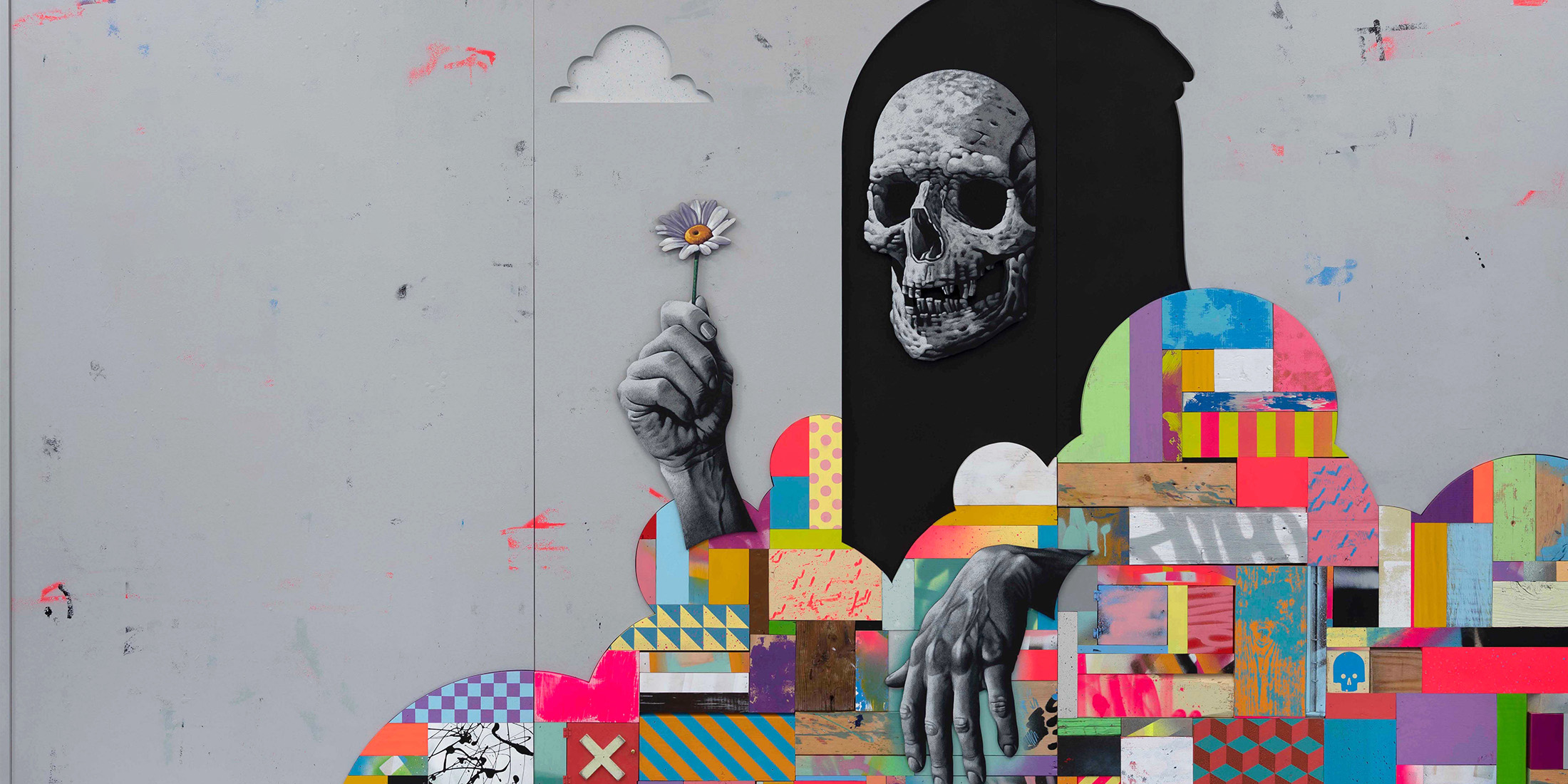
For Michael Reeder, a sketchbook isn’t just a place to draw—it’s a place to disappear. Moving between the immediate, public energy of street murals and the slow, layered solitude of the studio, Michael’s work captures the friction between life and its inevitable end. In this conversation, we explore the ‘urban contemporary’ label, the metaphor of layered wood, and why some paintings only feel finished when the artist finally stops pacing the room.

Tell us a little about yourself and when you first developed your love for art.
I’ve been drawing and making things for as long as I can remember. When I was younger, art felt like a place I could disappear into. It didn’t require permission or explanation, and I liked that independence. I could sit with a sketchbook for hours and feel like I was solving something, even if I didn’t know what it was yet.
My parents were really supportive and kept me involved in art programs through school, which helped me take it seriously early on. That mix of curiosity, problem-solving, and solitude is still basically how I work now. These days, I mostly operate as a painter, but I move between materials depending on what the piece needs. Much of the work centers on mortality, impermanence, and shared human experience, usually through figures, symbols, and surfaces that feel layered with time.
You describe yourself as an urban contemporary artist, how did you come up with that definition?
I didn’t come up with the term, but it’s one of the few labels that doesn’t feel completely wrong. My influences are scattered… fine art, graffiti, design, architecture, just growing up around cities and paying attention to how people move through them.
I’m interested in contemporary life and its contradictions, how things can feel chaotic and fragile yet strangely beautiful. My work tries to sit in that tension. “Urban contemporary” isn’t a strict identity for me, it’s just a useful shorthand for where my studio practice overlaps with street culture and public space.

How do you decide when a piece is finished, especially when ambiguity is such a big part of your work?
Deadlines finish a lot of paintings… that’s just reality. But outside of that, I know something’s done when I stop circling it. If I’m still pacing the studio (which I do a lot of), thinking about one more move, it’s not ready. When it finally feels stable, like it can exist without me babysitting it, that’s usually the signal.
Ambiguity matters to me because I don’t want to over-explain the work. I try to leave room for the viewer to meet it halfway. The trick is stopping before the piece gets overworked, but after it feels resolved. That’s a hard line to judge, but you learn it over time.

Your use of multiple mediums is what makes your artwork stand out. Where did these techniques come from?
It started as a practical solution. Early on, I was combining oil painting with spray paint and graphic elements, and those materials don’t always cooperate on the same surface, actually they almost never do. Building layered wood structures was a way to physically separate them and avoid technical problems.
But once I started doing that, I realized the construction itself could carry meaning. The layers started to feel like a metaphor for time, memory, and accumulation. Since then, I’ve experimented with everything from rubberized undercoatings to thermoplastic paint and concrete. At this point, the process underneath the image is just as important to me as the imagery itself.

What parts of your process feel the most instinctual, and which parts are the most controlled?

The imagery is the controlled part. That’s where I’m thinking about proportion, composition, and how the figure communicates. It’s slower and more deliberate.
The surfaces are more instinctual. That’s where I let materials behave the way they want to and react to what’s happening in front of me instead of forcing a result. I like that un
predictability because it keeps the work from feeling fresh rather than overly contrived and stale. The tension between those two approaches, control and reaction, is really where the paintings really click into that next level for me.

What’s it like going from a fine art gallery setting to a mural setting? Do you prefer one over the other?
They scratch different creative itches. Studio work is slow and internal. You have time to think, adjust, and let ideas evolve. Murals are the opposite. They’re immediate, physical, and public. You’re solving problems in real time, often with people watching.
I don’t really prefer one over the other because they influence each other. Murals make me think about scale, clarity, and how an image lives in public space. The studio gives me room to experiment and push ideas further. And going back and forth allows them to bleed into one another.

Skulls and flowers, do these themes play into your observations about the inexorable nature of human mortality?
They’re simple symbols that carry a lot of weight. They speak to cycles. Life, decay, renewal. Without needing much explanation. I’m drawn to that directness.
I’m not all that interested in them in a morbid way. It’s more about acceptance and awareness. Everything is temporary, and that can feel unsettling, but it can also be grounding. Those symbols help me talk about that tension without getting overly literal.
How has your style evolved since your earlier work, and what pushed those changes?
It’s been less about dramatic shifts and more about steady evolution. I try to stay open while I’m working because small discoveries happen all the time. If I notice something interesting, I follow it, even if I don’t know where it’s going yet.
Some of those ideas take years to really develop, but they can eventually grow into entire bodies of work. That process of discovery is honestly one of the most rewarding parts of making art. To stumble onto a morsel of an idea and devote the time and effort to push it into something much more elaborate and truly unique. It’s what keeps the work from feeling static and keeps me engaged with it.
Last word:
I’m grateful for everyone who’s supported my work along the way. That goes for individual collectors or galleries, brands etc. I’d be making things regardless, but it’s a lot more meaningful when people connect with it and invite it into their lives. Knowing that my work can bring a bit of joy or reflection to someone’s day is truly rewarding.


Leave a Reply
You must be logged in to post a comment.