

Peter Westermann, the visionary artist, Threyda founder, and accidental dropout on sacred geometry, wearable culture, and why we probably have a mushroom trip to thank for one the most successful movies of all time. Peter Westermann didn’t set out to build a global art brand. He dropped out of school, bought a printer, and got addicted to making things. That was the late 2000s, when psychedelic-influenced art was still a fringe internet obsession and nobody had a word for what he was doing yet. Now he runs Threyda, hosts weekly Art Rituals in Denver, and prints the kind of clothing people hold onto for a decade. The culture caught up to his aesthetic somewhere along the way – he’ll tell you Avatar is basically proof of that. His own work is hyper-symmetrical, mathematically precise, and somehow still feels like it emerged on its own. That’s intentional. He opens a door and lets the universe fill in the rest.
Let’s start by going back a few decades to when you first became an artist. How did you get started and how did the idea of “visionary art” come to fruition?
I was a graphic design student at a college in Wisconsin and drifted into the world of artwork around the same time as my first psychedelic experience. There was a lot of exciting activity online with new forms of art I had never seen before, and I fell deep into the rabbit hole of exploring what was possible. I ended up just getting addicted to making art – then found myself dropping out of school, buying a printer, and focusing on creating art and making a living selling my art prints.
The term “Visionary art” is a fascinating can of worms. Personally, I think it mostly applies to one very small category of work – made by people who are able to truly crystallize visions they had in an altered state. I think there are very few artists who can truly capture and recreate a vision – most of us are just making interpretations of feelings or glimpses of things that happened to us.

Your work often features intricate, hyper-symmetrical patterns that feel almost mathematical. Do you start with a specific geometric grid or “sacred geometry” framework, or do these complex structures emerge organically as you paint?
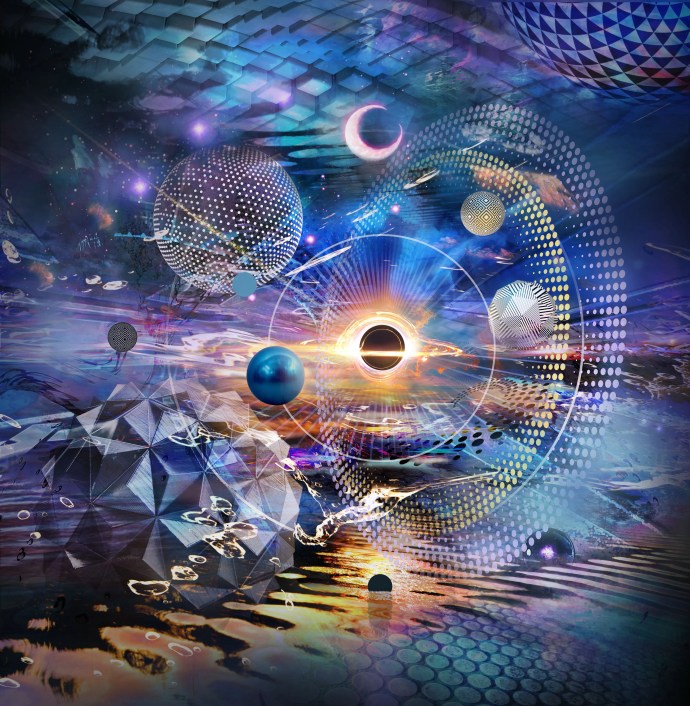
I like to pick one specific pattern as my framework, then let things emerge organically as I work through it. I want to see what kind of natural process can happen when I paint. Kind of opening a door for something to emerge from the rest of the universe, and how it interacts with itself.
Utilizing both digital tools and traditional acrylics/mixed media, how does your creative process change when you work on a physical canvas versus a digital one?
I find that due to looking at a screen I get tunnel vision with digital works – it’s a lot of zooming in and zooming out, which changes how you interact with the art. When I started painting, I started to fall in love with having a static physical object where I could consistently keep the whole thing in mind while creating.
As the founder of Threyda, what led you to start the creative studio?
When I first started my path as a full time artist, I eventually started helping other friends make prints too – and that, combined with always having an interest in custom clothing, I came up with the concept of a hybrid fine art + clothing brand that could support the creators I enjoyed. I had this distinct feeling that no one really knew how many incredible new styles of artwork were being made, and I made it a mission to try and amplify it as much as possible.
Threyda has a very distinct, cohesive aesthetic despite working with dozens of different artists. How do you balance maintaining a unified brand identity while allowing individual artists the freedom to express their unique styles?
I’m glad people see it as a cohesive set of creations. It’s honestly a bizarre job being a curator, and then seeing the results of that curation interact with the world. I think I mainly enjoy artists who sort of develop their own visual language, and who have an ability to create a distinct, open-ended experience that allows people to interact with their own interpretations and thoughts.
Many artists struggle with the “business” side of their careers. How does Threyda function as a bridge to help artists achieve financial stability without compromising their integrity?
I see my job as being to let the artists shine through whatever I’m doing. As long as what I’m doing honors the skill and effort they put into their work, then things amplify instead of diminish.


You’ve been at this since the late 2000s. Looking back at the early days of “visionary art,” what is the biggest shift you’ve noticed in the culture and how have you adapted to stay ahead of the curve?
It’s a fascinating journey that everything has gone through since the 2000s. Everything was mainly online, and mostly on the fringes of society when I first started – and over time, I feel culture has slowly become accustomed to more trippy and psychedelic influenced visuals. I think the art style of video games, movies, and many other things reflect that over time. For instance, I think Avatar is basically a mushroom-trip inspired experience, and it’s one of the biggest movies of all time. People became accustomed to and open to those types of aesthetics through technology.
Threyda is famous for turning complex canvases into high-end technical apparel. Why was it important to you that art be “wearable” rather than just something that sits on a wall?
The idea was basically that clothing is one of the oldest forms of culture alongside artwork. It’s how people share their communities and values – and so I hoped it would help bring people together and have the same effect clothing has had on cultures for thousands of years.

In an increasingly digital world dominated by AI-generated imagery, how do you, and Threyda, continue to double down on physical high-end prints and tactile clothing?
This new wave of generated art has taught me the value of human made art in a way that I never could have imagined. There’s an honesty and a distinct signature to anything made with regular art tools that I don’t think can be replicated. It also made me appreciate hand made art made with inexperience on a whole new level.

Threyda’s presence in Denver is huge. Every Monday, you host Art Rituals that bring the community together around a common cause of art and music. What have you noticed about the local community that’s been a building block of the brand?
When I got to Denver, I had a strange feeling of being treated more like I was at home than where I came from. I think one of the coolest parts about the city is that it’s always searching for its identity, and in that way, it has an open mind to new experiences. I think people in Denver have a lovely ability to be open to new things, and that’s really been a foundation for what happened with my project.

You are an artist yourself. How do you find the time to nurture your own creative practice while managing the massive administrative weight of a global brand?
The trick is having enough fun with something that you can’t stop, even if you tried. I find myself making things out of habit, regardless of what else is going on.
High-end “slow fashion” is a core part of your model.

How do you approach the challenge of creating products that are meant to last a lifetime in an industry that often favors fast-paced trends?
I like to think that when the culture swings one way too far, people start to appreciate the other side of the spectrum. When everything is mass-produced, people start to appreciate unique and more intentionally made options.

If you could envision Threyda ten years from now, are we looking at more immersive physical galleries, new mediums of art, or perhaps a different industry entirely?
In a way, I stopped imagining what could be next because there’s always something popping up organically and surprising me. I feel like I’m just along for the ride – and I never know where the ride will go next.

Any final shoutouts?
Big shouts to anyone who followed the call to create, and everyone who supported them to complete the cycle – it’s one of the most ancient and meaningful ways we can connect as humans.

