


In a creative landscape reshaped by AI, algorithms, and endless content, Absorb81 is doubling down on the one thing no machine can replicate: his voice. We caught up with the artist on originality, evolution, monsters, and staying human.

The last time you sat down with Rooster was 2019. A lot has happened in the world since then. A global pandemic, the rise of AI, algorithm shifts on Instagram, etc. What’s shifted most in how you work or the work you’re creating in the years since?

I’ve always treated art as something I genuinely enjoy first and foremost. You know the saying, “Do what you love and you’ll never work a day in your life.” That’s bullshit, by the way. If you don’t adapt to the changes around you, you’ll be broke and homeless pretty quick.
I’ve been complaining about AI for a couple of years now. For a while, it honestly felt like I’d spent decades learning a craft that was about to become obsolete. But I think the cookie-cutter designers are the ones getting replaced first. The only way to stand out in this new AI world is to… stand out. Approach ideas differently. Bring something personal to the table that a prompt can’t. At least that’s what I’m telling myself.
I’m still hopeful there’s a place for me in the years to come. I suppose driving a forklift at Home Depot wouldn’t be the worst thing in the world.

Your work has an unmistakable graphic punch. We’d recognize your work anywhere. Heavy inks, blocky shapes, broken anatomy, lettering that feels carved more than drawn. When did that “voice” click into place for you, when you knew an Absorb81 piece had to look a certain way?
I don’t think there was a single moment it clicked. It happened gradually as I stopped chasing trends and started drawing the way that felt natural to me. The more I trusted my gut instead of worrying about the “rules,” the more the work started looking like me. At some point I stopped trying to create a style, and it just became the way I draw.

You’ve said before that you’re more interested in twisting reality than recreating it. At the start of a piece, are you reaching for a specific deformation, or do the weird bits show up on their own once your hand gets moving?
I usually have a pretty good idea of where I want a piece to go, but it almost always morphs into something more interesting while I’m sketching. That’s really where the fun is.
I’ll be honest, though, sometimes it morphs into something I’m not happy with. Other times it takes such a hard turn that the entire subject changes. That’s part of the process. You have to let it wander a little and see where it ends up.
Your “ORIGINAL FIRMWARE” piece reads as a clear stance on the human element in art at a moment when AI is muscling its way into illustration (and everything else for that matter). How are you thinking about your role as a working illustrator right now, and has the AI conversation changed what you put out into the world?
AI has definitely changed the game. I’ve lost a lot of clients and I’m sure plenty of potential clients to AI.
Honestly, I can’t completely blame them. If you’re lying awake at 3 a.m. and can pull out your phone, generate ideas, make a flyer or T-shirt design in minutes for basically free, and skip the back-and-forth with a designer… I understand why people do it. I’m not happy about it, but I get it.
I’m trying to stay hopeful that human-made artwork will still be appreciated and worth investing in, not just for clients, but for collectors too. I think there will always be people who value the story, experience, and imperfections that come from something made by another human.
What content are you currently consuming that you’d recommend as a must-watch? (Netflix, Hulu, HBO Max, Paramount+, etc.)
I absolutely love Robert Valley’s animation in Love, Death & Robots. His art style is incredible, and the animation is just ridiculous.
Honestly though, I haven’t been watching a ton of new stuff lately. I’m probably on my hundredth rewatch of Breaking Bad.
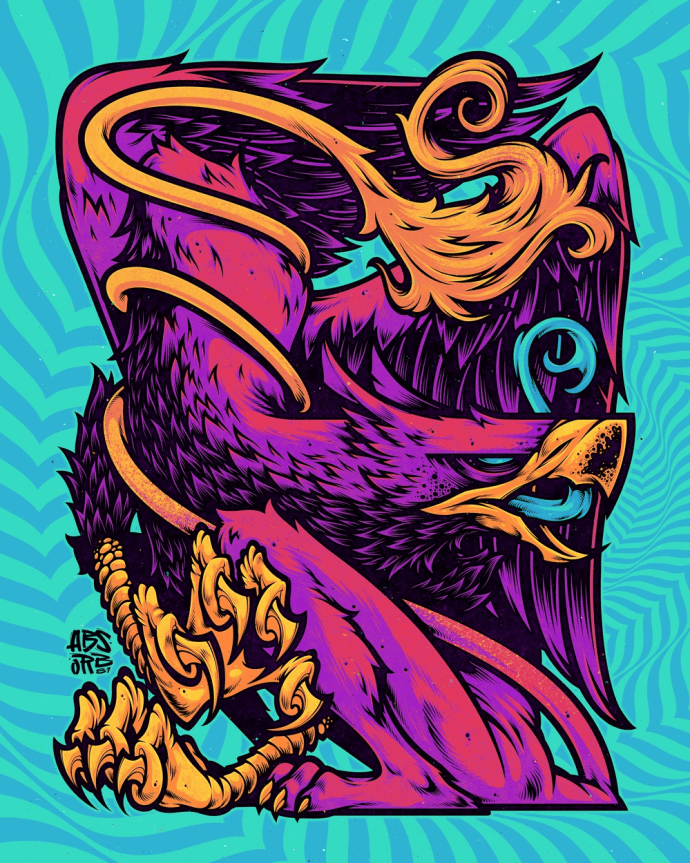
A huge chunk of your catalog is mascot and creature work like; chupacabras, foo dogs, bull skulls, octopuses, beasts of every flavor. What does a monster give you to work with that a clean wordmark or logo doesn’t?
I just love drawing characters. There’s so much more room to explore shape, expression, and personality than there is with lettering or logos. There are fewer rules, and I think that’s what keeps it fun for me.
We know it’s like asking who your favorite kid is… but what’s your favorite piece you’ve ever done?
That’s a tough one because it changes almost daily. Some days I hate all of them. Ha.
Right now, though, I’d have to say Suicide King. It turned out really close to what I had in my head, and I still enjoy looking at it.

Beyond client work, you’ve built out a whole independent ecosystem; fonts, templates, prints, skate decks, sticker packs, and more. What pushed you to start making stuff for other designers and creatives, not just for clients?
I figured if I was searching for a certain lettering style or template, there were probably other designers looking for the same thing. So instead of making it just for myself, I decided to package it up and share it.
The Vernon Courtland Johnsons and Todd McFarlanes of the world were the gods on the wall when you were coming up. Have any of those original heroes shifted in the rotation over the years? Anyone fading, anyone newer who’s pushing you now?
The artists who got me interested in drawing in the first place will always be on the list.
That said, social media has opened up a whole new world. I’m inspired almost daily by artists I discover on Instagram. It makes you wonder how many insanely talented artists were out there in the ‘90s but never got the exposure because there wasn’t a platform for them.
Social media can be pretty toxic for your mental health, but it’s also given a lot of artists, including myself, a chance to share our work with people all over the world.

Disc golf has been a constant for you since ‘08. Does the course feed the studio at all? The time outside, the slower pace… or is it deliberately a place where work doesn’t follow you?
Man, I rarely get out for a round these days.
Honestly, running has become that creative outlet for me. That’s when a lot of ideas seem to show up, usually while I’m slowly destroying my knees. The gym is the same way. Something about moving around without staring at a screen helps clear my head.

If you could send one thing back to the screen-print-shop version of yourself in the early 2000s — a piece of advice, a tool, a heads-up, anything — what would you send?
Record more. I get so caught up in the process that I forget to set up a camera and hit record. Looking back, I wish I had documented so much more.
And I’d definitely remind myself that less is more. I’ve made prints with six or seven colors that I thought were great, but the two- and three-color prints almost always looked better and sold better.

Last time we spoke, you mentioned possibly getting into some online tutorials and process videos. Is that something you’re still interested in kicking off?
Absolutely. It’s something I need to do.
At the very least, I need to start recording more process videos, whether it’s an illustration or a screen print poster. I love watching that kind of content myself, so it makes sense to share my own process too.
Hopefully people find it useful… even if it’s just as a lesson in what not to do. Ha.

