
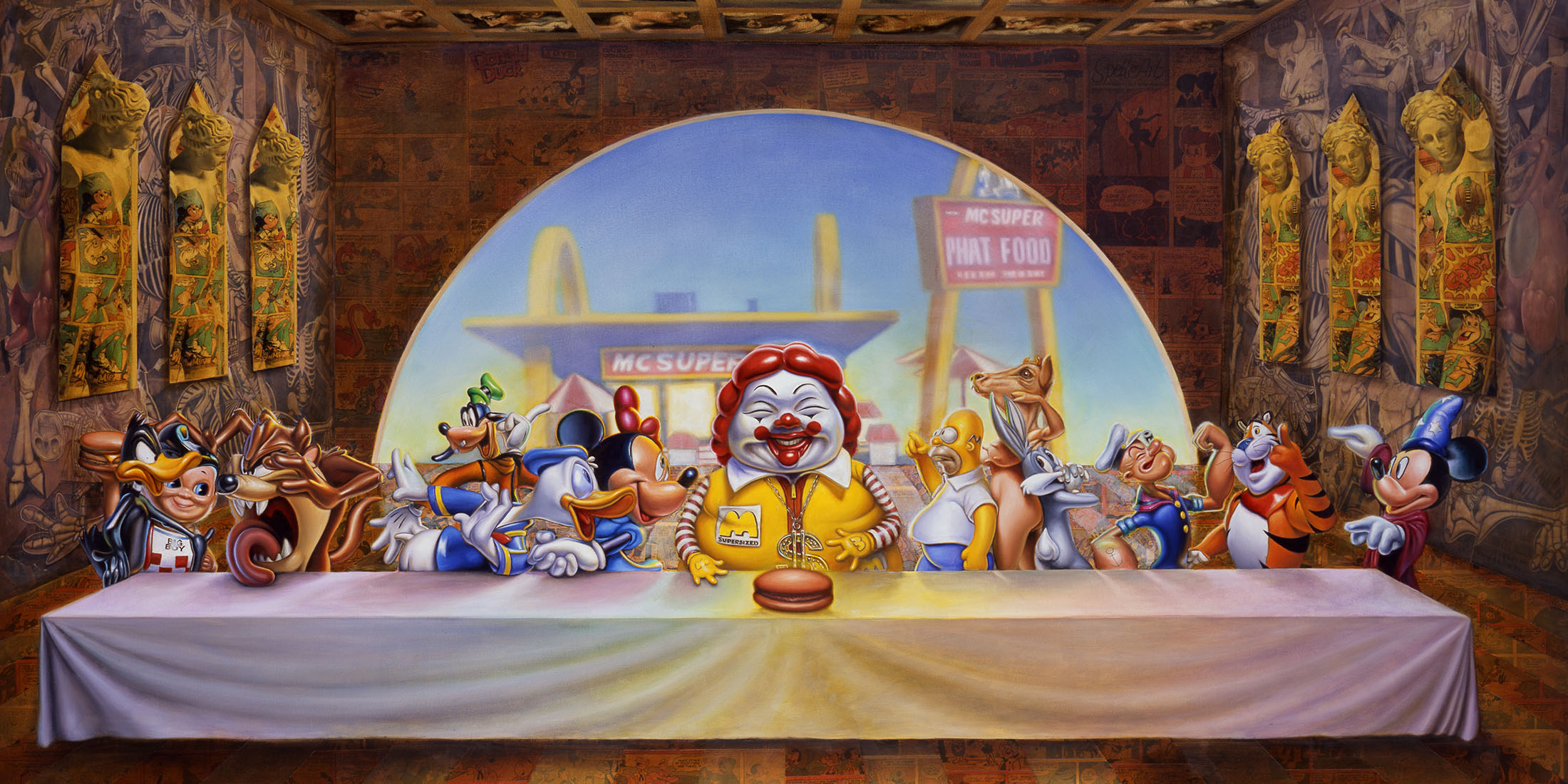
Ron English is one of the most influential and mischievous voices in contemporary art, known for hijacking billboards, brands, and pop icons to expose the absurdity beneath American culture.
Often called the godfather of street art, his work blurs cute and disturbing, humor and critique. We spoke with the artist as English reflects on childhood rebellion, culture jamming, selling out, and why art isn’t about changing the world—it’s about flipping the channel with less commercials and more questions.
Tell us how you got into art and a little bit about the journey to where you are now.
My art career began on the wall in arms reach of my sister’s crib. I was in kindergarten and had made an amazing peacock out of strips of colored construction paper. I was so proud, I couldn’t wait to get home and show it to my kid sister. I was so sure she would be delighted by my creation, and she was. She grabbed it with enthusiasm and proceeded to shove it in her slobbery mouth. It was ruined, and I was devastated. I vowed revenge, so I grabbed some crayons and made a mural on her wall and signed it with her name. Oh boy, was she going to be in trouble! Well, my mom found it and proceeded to give me a stern spanking. I was dumbfounded. Couldn’t she read? Couldn’t she see the signature of the culprit, “SUSAN”?
You’ve been called the “godfather of street art.” How do you feel about that label, and does it still resonate today?
I know in the graffiti culture there has been a strong push to figure out who did what first. When Street Art got big, there was a similar scholarship that concluded I was, in fact, the Godfather of Street Art, which, by the way, is the biggest art movement in the history of planet Earth, so, pretty cool. I do get annoyed when it distracts from my central practice, painting, but in the scheme of things, that’s a complaint that merits no air time.
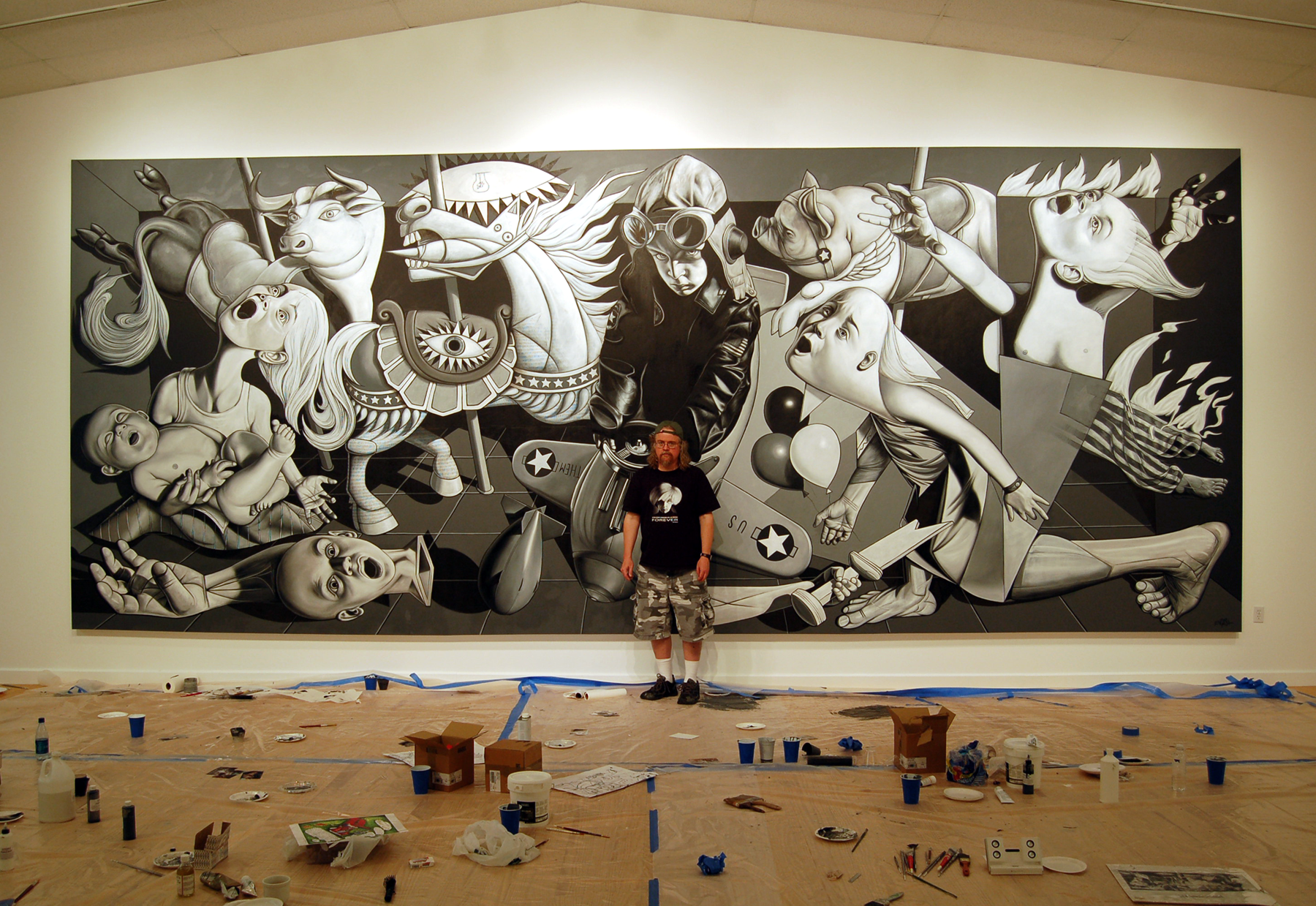
Your work often hijacks familiar corporate imagery—what makes a symbol “ripe” for culture jamming?
There are two sides to a coin, but every toss seems to land on the coin on heads. But there is a tail on the other side that makes for a great story and I am happy to tell it.
How has your approach to subvertising changed as brands themselves have become more self-aware and ironic?
Well, they say “the revolution will go unnoticed” or something to that effect, whoever they are anyway. At this point, it may be that we are the new they.
Many of your characters blur the line between cute and disturbing, why is that tension important to you?
I don’t believe there should be a line between the two. We should be able to actively ignore everything equally.
What role does humor play in disarming viewers before delivering a deeper critique?
If you can make fun of something, then there’s probably something funny about it that should be considered. Everyone loves to laugh, no one loves to get laughed at, unless you’re willing to throw yourself under the bus too.
Has the mainstream acceptance of street art weakened its ability to challenge power, or simply expanded its reach?

Well, it’s pretty much muralism now, with some fun exceptions. But the acceptance of art is a big deal. When I was coming of age, some uppity folks were praying in front of blurry squares in a museum while everyone else just thought art was a stupid way to bully the lower classes. Everyone was missing the point from every angle.

How do you decide when a piece should live illegally in public space versus in a gallery or collectible format?
Street Art is of the moment; it doesn’t last, that is not the ambition of that art form. A painted picture has to be relevant and intriguing for a thousand years. You have to think in the now and in the forever.
Your work frequently references fast food, advertising, and mass consumption—do you see these as uniquely American problems?
I think they are being successfully exported.
How has social media changed the way people engage with subversive or political art?
I think social media mostly just overwhelms people.

What responsibility, if any, does an artist have to provoke discomfort rather than offer comfort?
We have the luxury of travel, meeting all sorts of people from the top to the bottom, and being able to engage deeply with them, combined with endless hours in the studio where we can listen to history podcasts, books on tape, the voices in our heads. All that gives us a unique perspective that we have the ability to illustrate and share. But art is like a new pair of leather shoes; at first, they may be uncomfortable, but eventually your feet make them your own.
Looking back, which piece best captures what you were trying to say at that moment in your career?
The Charles Manson Think Different billboard.

Any shoutouts or final words?
Art doesn’t change the world; it changes the channel. Hopefully, to one with less commercials.
Leave a Reply
You must be logged in to post a comment.