

Daisy Patton gives forgotten photographs a second life.
A multidisciplinary disabled queer artist, she was born to a white mother from the American South and an Iranian father who she’s never met. An artist by trade and storyteller at heart, she collects discarded photographs of strangers and transforms them through extravagant colors and floral portraits. Her work explores the idea of “story-carrying,” asking who gets remembered and who disappears.

Her upcoming exhibition, In The Place of Flowers, will be held at Denver Botanic Gardens Sept. 19, 2026 through Jan. 31, 2027.

Where do you normally find your photos, and what draws you to these images?
In the past, it was a mixture of searching in person—thrift stores, antique malls, flea markets—and online, with some instances of people gifting me their own photos/photo collection. Now, it’s mostly online.

I’m looking for something in the photograph that gives a sense of self or likeness embedded within, such as a gesture or glance. I’m interested in the idea of a living archive of memory, as well as the questions, who do we remember and why? Who gets to be remembered and held within collective memory?
I also collect around things that are personal to me, my family, and my loved ones. Iranian photos are especially dear because of my father, women and queer relationships, our interactions with nature, and mourning photography.
Your work often returns to people who are disappearing. When you look across your work, what themes connect them?
These themes permeate my work: memory, loss and grief, absence and presence, our shared humanity, and those disappearing or being forgotten and how we can reverse that and why we must.
In a very broad sense, I see some of these as kinds of hauntings. Some are very personal ghosts, while others are collective ones, lingering until we finally reckon with their past and this present.
And, above all these themes, love and carework—I think all of us have value, intrinsically worthy of love, and capable of caring for each other beyond the systems in place that seek to crush those humanistic impulses.

Do you see your work as an act of preservation?
I do see the Forgetting is so long series as a living archive of memory, but they’re not my memories, and I don’t know the people.
I have always been obsessed with preservation of different kinds. As a previous history major, I believe the stories and histories from the past help us understand ourselves and our current moment better. The people from the past are the same as people as today, just with different (but often more similar than we think) circumstances. I feel the same approach to a radical shared humanity breaks past space and time barriers.
How is In the Place of Flowers different from your previous exhibitions? What were you trying to do that you hadn’t done before?
I tend to approach exhibitions as exploring a theme or type of photograph. I’ve painted funerary and mourning imagery, weddings as aforementioned, nature, women and female relationships, and families.
When Jen Tobias from the Botanic Gardens reached out to me for this show, I knew I wanted to focus on flowers and how humans have used them over time. The show incorporates ayeneh-kari, or Iranian mirror work, found objects like quilting squares, and of course, a lot of fabric flowers.
The Botanic Gardens describes this exhibition as a celebration filled with beauty and joy. That’s different from some of your work confronting grief. Was that intentional?
I would honestly say that for me, this is not a shift but rather just what it’s always been. Grief and loss are always mixed with love, beauty, joy. To mourn someone we no longer have in our lives means to remember them, to recall memories that could be happy, complicated, frustrating.
The Place of Flowers is lighter in some ways, but I like to use beauty as an opportunity for people to be drawn in and then think about others, their relationships, our surroundings.
In the making and planning of this show, my mother passed away, with whom I had a complicated relationship. Even at the beginning of Before These Witnesses, I nearly died from a pulmonary embolism mere days after confirming the show.
Our lives are so short, we live in difficult times, and yet we still have to find a way to live, to love, to care for one another, to find whatever crumbs of happiness or contentment that can allow us to keep going.
It’s why I suggested the poem for the show, where it gets its title: Sohrab Sepehri’s dar golestané, where he says, “life is not empty/there is kindness.” I see the photographs I work with as precious, as artifacts that give glimpses into what was, while also reflecting what is and what could be.

Flowers allow us to gift something that can be full of meaning that is hard to express in writing. In the lead up to my near death in 2021, I had urgent neck surgery, and someone sent me flowers. I still have no idea who that was because no name was left on the card (if it was you, dear reader, please tell me!), but that demonstration of care meant a lot to me at that moment.
Reading about the sites of ancient human remains containing flower remnants tells us about how much we are the same – that these beautiful objects from nature contain so much meaning.
I remember being at the Smith Art Museum where a falling petal off a flower was meant to symbolize our mortality, that life is fleeting. It reminded me of why I chose floral patterning and flowers that are always alive and vibrant: I want a way to signal that disruption of time.
The flowers in these pieces aren’t simply decoration. They almost seem to create a new environment around the people in the photos. Are you building a place for them to exist?
I’ve been drawn to patterning from a young age, not realizing how much that was reflected in some of the Persian miniatures I would look over as the one item I had that hinted at my father.
I do see floral patterning as its own life force. The flora emerging from the figures is something physically attached to them; if they stepped out of the picture frame into our realm of existence, they would have these botanical items as part of an almost hybrid figure. It’s a way to denote the cycles of life and our own place within that, as well as our home in the natural world.
All of the adornments for me are acts of devotion and care for the people I am painting, so in that way, it can be a place of beauty and joy that I am building for them. The paintings have always felt like a portal, that we are being visited by these people who are enlivened again.
Maybe we can learn something from recognizing that we are all connected, that our fates are bound together.

Can you tell me about the story of one photograph in this exhibition, from the moment you found it to the moment it became a finished painting?
I’ll focus on Untitled (Clara Armstrong). I found her on eBay and instantly fell in love. It was listed as a post-mortem photo, which I realized when zooming in that not only was it not, but that she was a florist standing next to her creations.
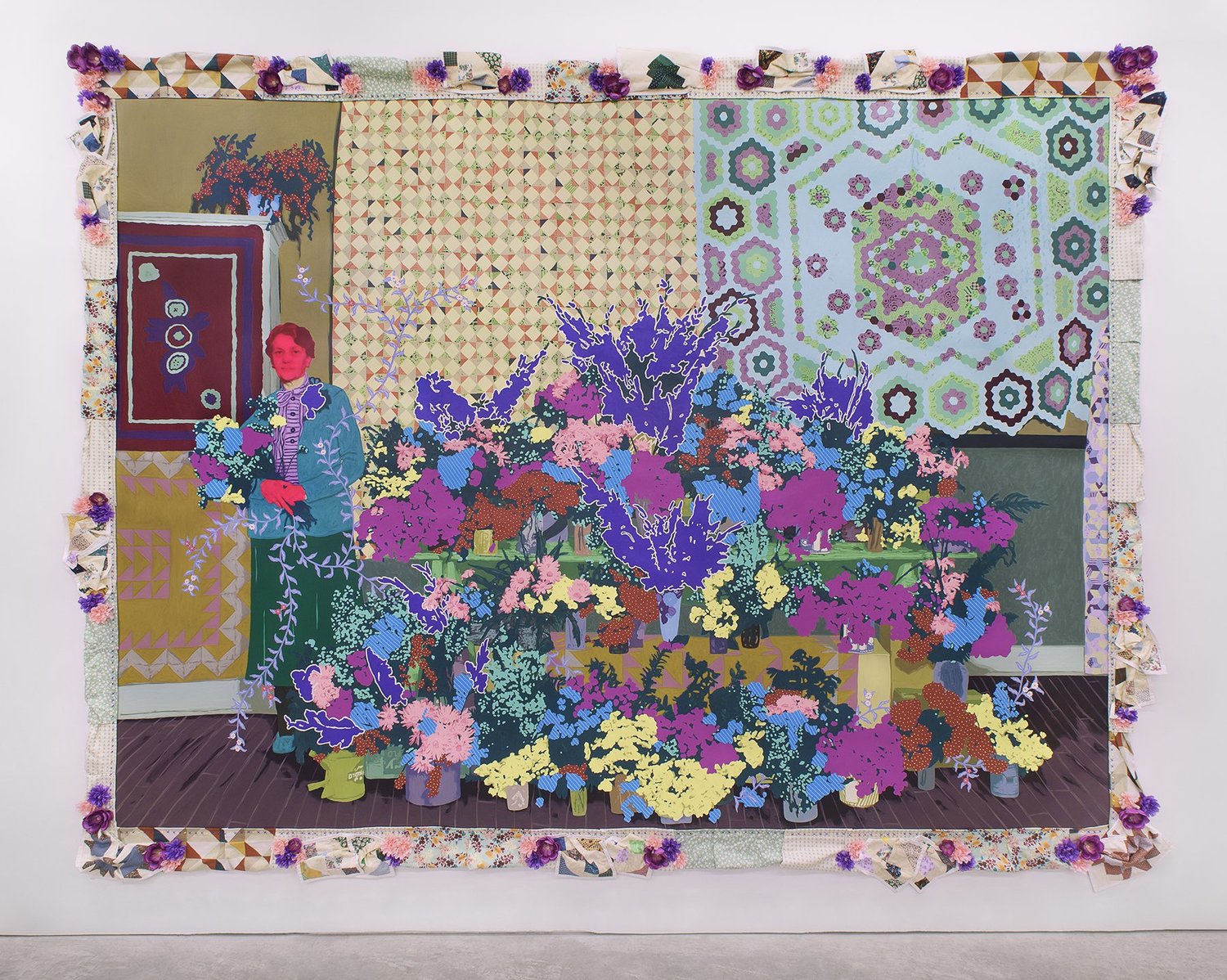
Behind and all around her are elaborate quilts. She resembles my Granny slightly, who I am named after and who also did some quilting, as did my mother. The image felt like a perfect way of encapsulating both sides of my family: this my mother’s, the Iranian photos my father’s
I knew I wanted this to be on canvas because I wanted to incorporate fabric flowers and found quilting items around the painting. It ended up becoming the largest painting I’ve made thus far. Rendering the quilts was a massive challenge and took weeks.
I see the canvas paintings as a kind of Persian miniature made monumental, and I usually select floral or patterned fabric to surround the painting. In this case, I found some antique quilt squares. My amazing studio assistant Felicity Wababa sewed backings onto these frail objects, and they all looked like mini quilts themselves.
It took four people to move this painting each time and really pushed the limits of what I have been able to do.
