
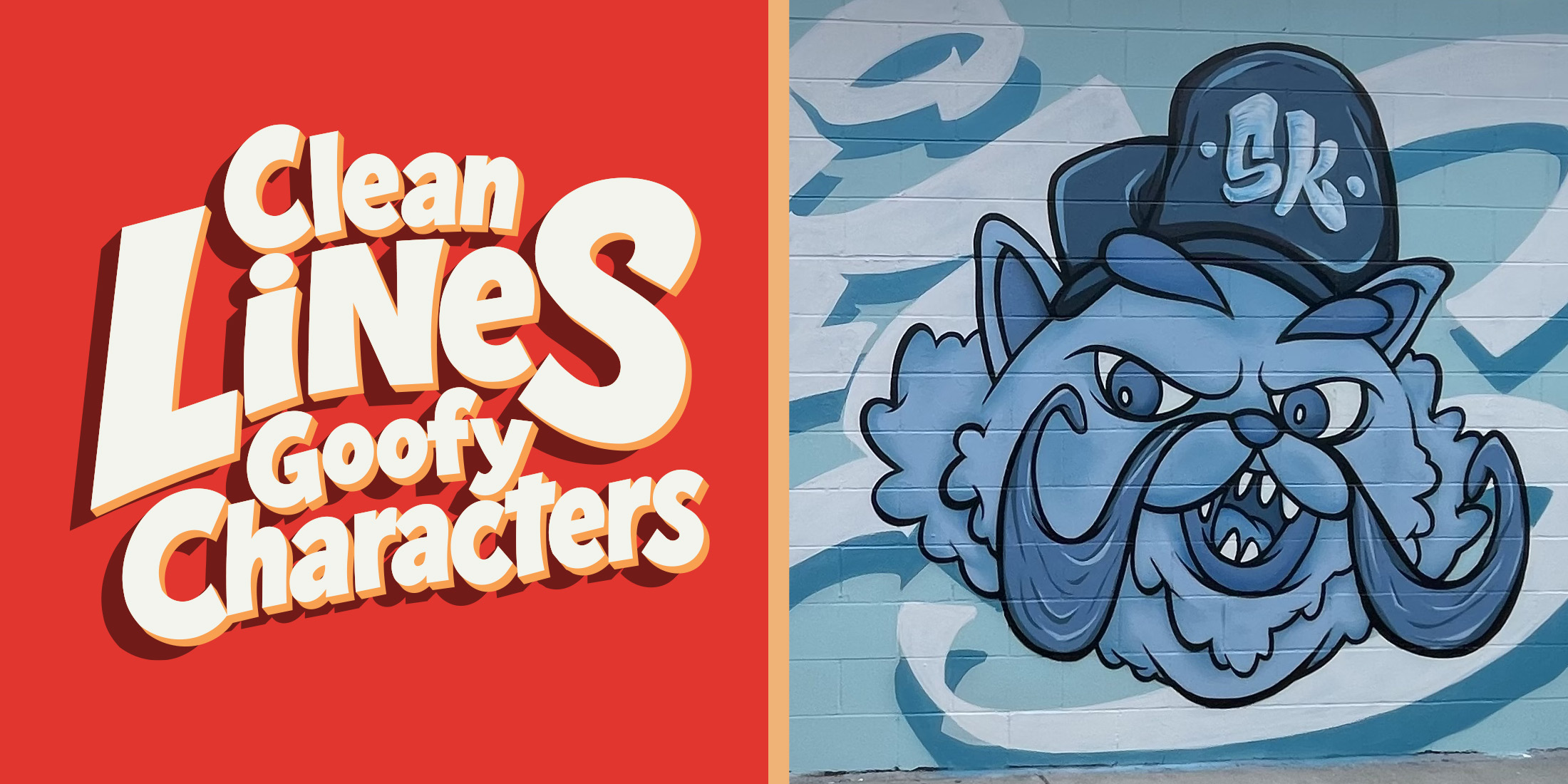
Mike Graves has been leaving his mark on Denver walls since before half the RiNo murals were even a mood board. His characters are simple on purpose, his lines are clean by religion, and his philosophy hasn’t shifted much in 25 years: make art for yourself, keep it crisp, and hope it puts a smile on someone’s face on their way to work. He’s painted massive multi-story walls, tiny gallery pieces, and a few things in between. The city has changed around him, gotten slicker and more corporate and a lot more nervous. Graves hasn’t. That’s kind of the point.

When did you first get into art and when did you know this was the path you wanted to take in life?
I started drawing at an early age. I think in High School it began to seem like it could be
something I would do all my life.
We’re huge fans of the characters you’ve created. How have these figures evolved over the years, and do they have names or backstories that the public doesn’t know about?
They have evolved over the years, and I have simplified them a lot. When I first started them they were way more complicated than they needed to be. Most of them are versions of myself and my friends or how I’m feeling at the time.
Your work manages to be incredibly playful while maintaining a professional, clean edge. How do you find the balance between “fun” and “fine art” when approaching a new canvas?
I think the key is keeping it as clean as possible. If you paint goofy characters but the lines are crisp, it still has that professional appearance. Craftsmanship is key.

You’ve been a key part of Denver’s mural scene for a long time. Looking at the art scene today versus ten years ago, how do you feel the local art culture has shifted?
It has changed a lot, especially in the public art scene. In my opinion ten years ago artists were allowed more freedom to be creative. There was less opportunity to paint highly visible walls, but we were able to pretty much paint what we wanted to. Now with the influx of more money and corporations owning whole city blocks instead of individuals, it lends to a more curated look, where self expression and individual style aren’t as important as it used to be. There’s still a good amount of local artists pushing forward, so I hope that it will get back to the point where the building owners aren’t so afraid of offending someone and give the freedom to create back to the artists.

Is there a specific spot in Denver or a particular Colorado landscape that consistently recharges your creative batteries?
In Colorado, it’s definitely the mountains.

When you finish a massive public mural, what is the one thing you hope a random person feels when they walk past it on their morning commute?
Honestly, I just hope it puts a smile on their face and maybe makes their day a little better. It’s hard out there these days, any little thing can help.

The work you do includes small gallery pieces and massive multi-story walls. What is the biggest mental adjustment you have to make when moving from a handheld brush to a spray can or a lift?
Mentally, there’s not a difference for me, but physically there’s a difference. The older I get, the smaller more intricate pieces are more challenging to get my hands working right, especially on smaller toys.

You’ve done some incredible collaborations (like those with Chris Haven). What is the secret to a successful “mural jam” where two distinct styles have to live in the same space?
My favorite collabs are the most spontaneous ones, where there’s a basic plan but nothing is set in stone. It’s just a group of artists doing what they love to do and I think that always shows in the final product. The most organic walls are usually my favorite.

In street art, there’s no “undo” button. Can you tell us about a time a “mistake” on a wall actually turned into one of your favorite parts of the piece?
For me it’s kind of the opposite. Painting in the street, it’s so easy to change things up or fix it. Spray paint is super forgiving that way. I tattooed in my early 20’s and there’s no “undo” button in that profession. All the love to my friends who tattoo out there!
With the rise of digital tools and AI, how have you integrated (or intentionally avoided) technology in your traditional painting process?
There’s a time and place for all of it. I was brought up with more old school values and paying dues, so the digital tools aren’t really me. I do use Procreate for digital work and refining sketches.

If you were given a blank check and total creative freedom to paint anything in the world what would it be?
That’s a tough one. I’d have to say I would travel as much as I possibly could and meet up with friends along the way and just leave a mark wherever we go. There’s so many places in the world that I would love to see and meeting people along the journey would be a dream come true.

Any final shoutouts?
Olive, Melissa, my parents and all my friends who have helped me out throughout the last 25 years, especially Tuke, Birdcap, Gamma, Emit, East, Ravi Zupa, Aiko, Jaime Molina, Faives, Scribe, Worm, Wen2, Abstract and Plastic Chapel.

Leave a Reply
You must be logged in to post a comment.