
Some people’s offices are filled with stationary and ugly fluorescent overhead lighting. For Boulder’s fire management crew, their office is filled with elk skulls, chainsaws and enough flammable toys to make a pyro blush.
“Usually you wanna use gloves but…” Kyle Holsinger shrugged as he set up the drip torch. He grinned as he sprinkled fuel on the ground and watched it ignite. “Primitive yet effective,” he said.
“I used to have a big fascination with fire,” said Holsinger. “Safely,” he added. For Holsinger and his team, the job is controlled chaos – and it’s just how they like it.
Long before smoke fills the air, these outdoor enthusiasts, chainsaw-lovers and self-proclaimed pyromaniacs keep Colorado’s forests safe. The restless Boulder County Sheriff Fire Management Crew comes from an array of backgrounds: an accountant, a landscaper, an airplane deicer, an electrician, forest service workers, a triathlete. But many seem to share the same philosophy:
“You do it for the experience. You do it for the camaraderie. You do it to set shit on fire.”
Their primary mission is broad: suppressing fires, supporting ongoing forestry health and long-term fire prevention through prescribed fire and wildfire mitigation services. Much of the job is spent on forestry projects and training, while the rest is a mixed bag of public outreach, education, emergency response and dispatch assignments. Many mornings at the station begin with runs, weightlifting and perfecting firefighting skills.
“We train for the worst while always hoping for the best,” said Holsinger.
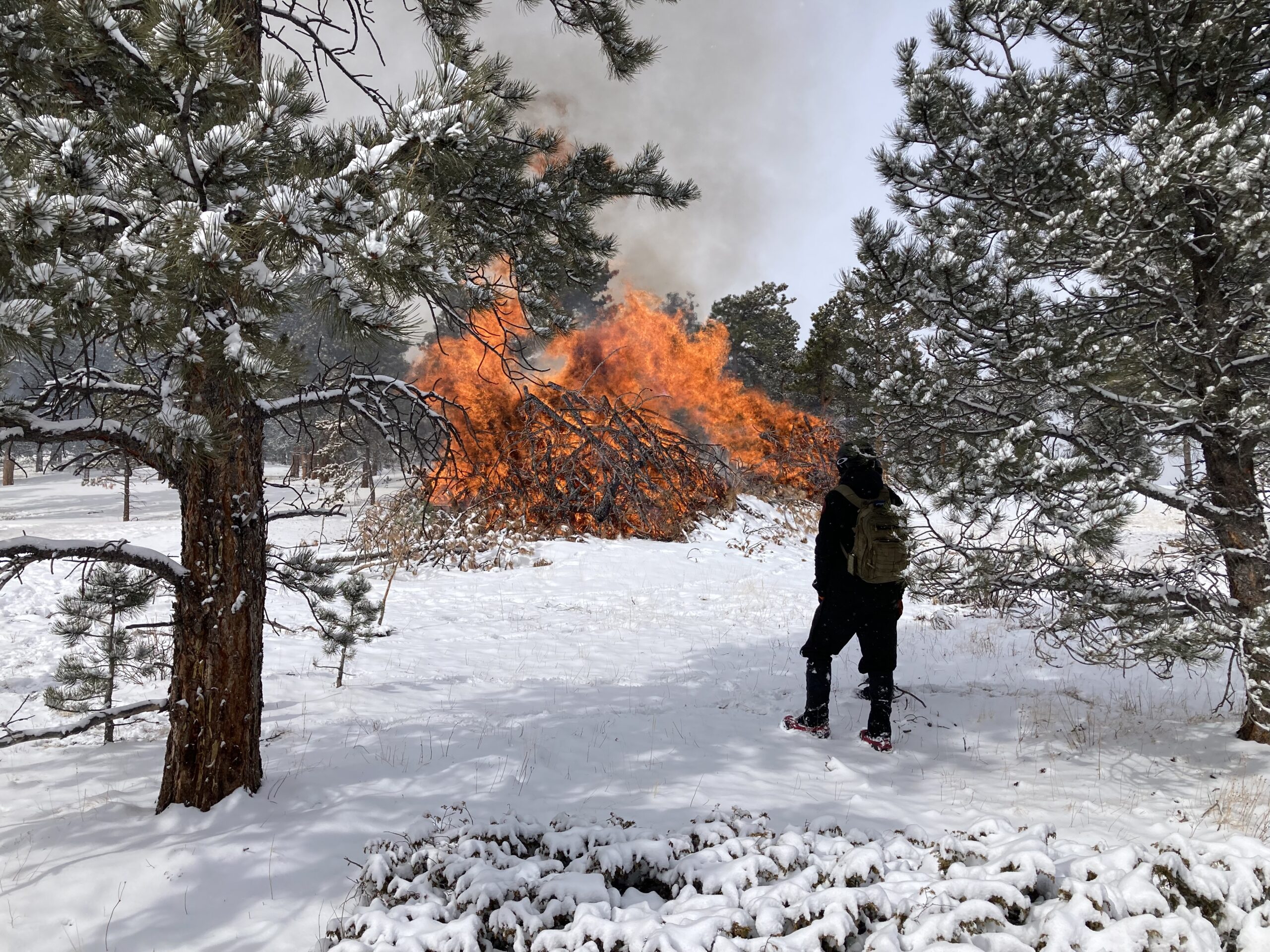
What might look like destruction is often prevention. Prescribed burns are one of their most important tools. Intentionally and carefully burning grass and other vegetation reduces the amount of fuel available for future wildfires. Fire is vital for forest health, Holsinger explained, and helps improve soil health while reducing invasive species.

Fire management often becomes a series of side quests, from chasing lightning to responding to airplane crashes in remote canyons. Come fire season, Boulder County callers get antsy. The fire crew addresses worried calls about smoke coming from literally anything – construction sites, trains, chimneys or the ominous low-hanging cloud.
Other response efforts are more thrilling, like when the fire crew was called to babysit “a nutjob in Nederland” who had some bombs in his house. The team watched as a bomb-disposal robot went in and blew them up with a box. Just another day, another dolla.
But Boulder County fire crew’s biggest fear isn’t fire – it’s idle time.
“I’m ADHD as shit. I need something shiny in front of me,” said Holsinger.
The anti-desk job crew refuses to sit still. Fifteen years ago, they flipped their station, an ex-flooring shop, into what it is today. They built their own lockers, a gym, a wooden bench reinforced with an old fire hose and a room housing at least 20 chainsaws. Morning briefings happen around a homemade table, the centerpiece an entire elk skull. The offices are filled with sheds, a Schwarzenegger poster, hot sauce bottles above framed pictures of fires and a picture of a T-Rex sitting on the toilet, its arms too short to reach the toilet paper.
There is more to the job than meets the eye. “Everyone wants to be a firefighter until it’s time to clean up. When the gangster work is done, it’s not really that fun,” said Trevin Montano. From rolling up 100 feet of hose to the “mop-up” process after the fire, when the crew goes through with their hands to make sure the area is cold and the fire is truly dead, it’s a job with lots of depth, mechanics, planning and communication in high-stress moments.
“Fire will tell you what it wants to do. You just gotta read it,” said Montano.

When you aren’t playing with chainsaws, digging or cutting trees for hours, said Cameron Reed, it’s like you’re a chess player. As their work varies day to day and season to season, “you just go,” said Holsinger. You carry your equipment into forests with no trails in towns you’ve never heard of.
To be attracted to the world of fire management, said Holsinger, you gotta be a little crazy. It’s people who can’t sit at desks, who like the outdoors and who have a desire to help.
“We’re all a little off,” said Holsinger. He dreamily recalled a day spent blowing through boxes of hand tosses and 150-ft flames as if it were his Disneyland. Their souvenirs of choice: fusees (flare dynamite), drip torches, fire-shooting paintball guns (Pyroshots), hand tosses and Veri pistols.
The job is not without its challenges. Crews can be in the field for weeks at a time, working long hours far away from family and friends.
“It can be hard to go from 1,000 miles an hour to nothing,” said Reed.
For Holsinger, the scale of the work can also be disorienting.
“It’s hard being this little speck on something this big,” he said. “You can’t put a tornado out.”
The work often goes unnoticed. Without a fire management team, Holsinger believes, fires would grow larger and more catastrophic. But to the average Joe, grass grows back, homes get rebuilt and life goes on.
“Not to discount what we do at all, but for the most part, we’re in the woods putting the fire out,” said Holsinger. “All people see is there is no smoke where the smoke used to be.”
Still, they stay. Not because it’s easy, not because it’s lucrative. But because they love it.
For many on the team, the appeal is simple: every day is different. Their job takes them to places they never expected to see in places they’d never end up otherwise. As Holsinger recalled, the draw is ending up in places like Glacier National Park, standing between a glacier and a blazing fire.
“That’s the drug that gets you hooked,” he said.
“You don’t get into this job to make money,” Holsinger said. A former accountant who once imagined he’d be a hotshot businessman, he left his lucrative career to make $12 an hour in the forests of Arizona. And he hasn’t looked back since.
“I wouldn’t want to do anything else.”
Leave a Reply
You must be logged in to post a comment.